Private Sale Car Value Calculator
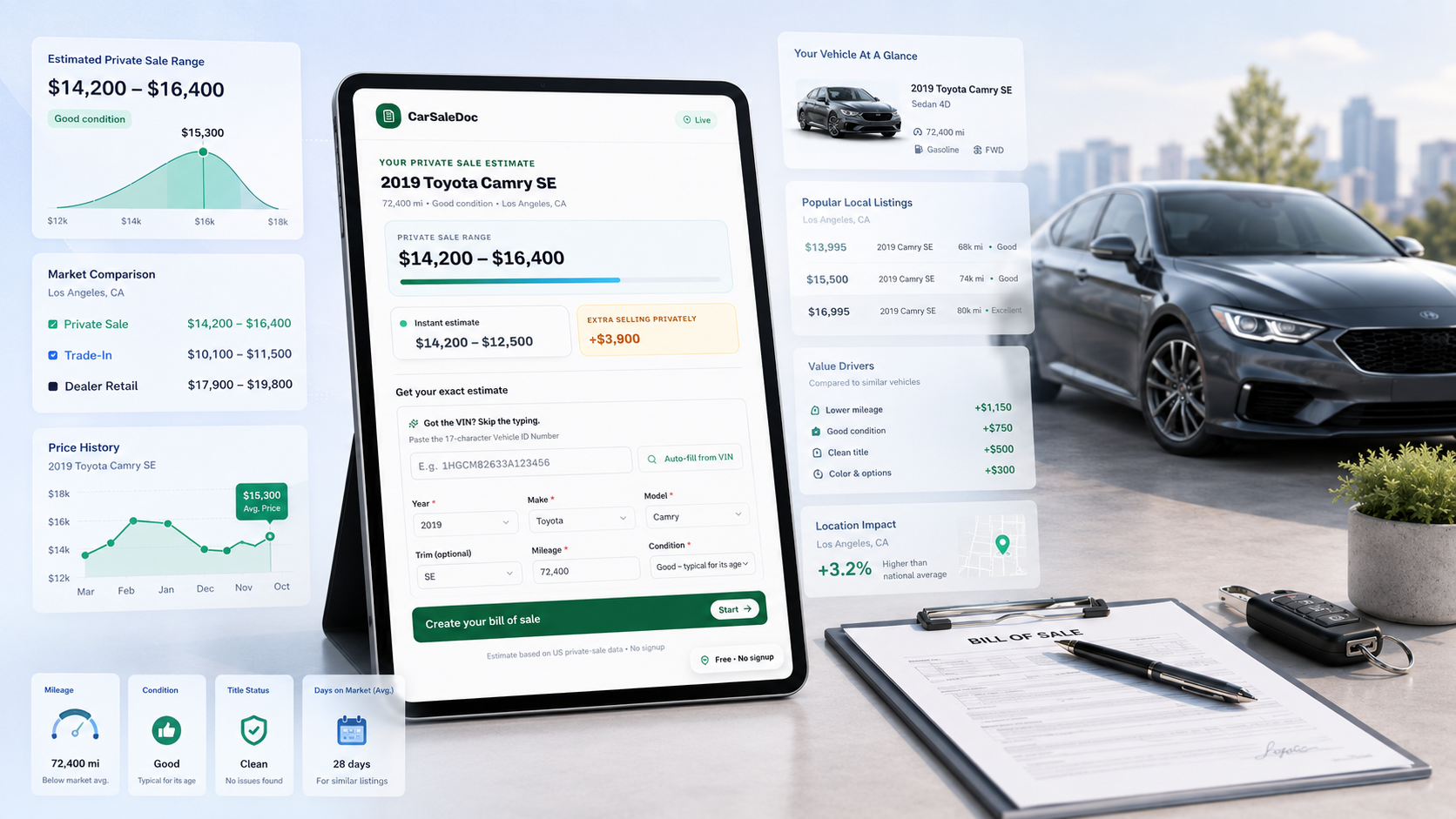
Estimate what your car could sell for in a private sale based on mileage, condition, title status and location. See how a private sale compares with trading it in at a dealer.
Calculate by state
Prices, demand and DMV rules vary by state. Each state page below adapts the calculator and adds local market context (tax rules, seasonal demand, top-selling models).


Not in these states? Use the main calculator above — it works for every US state and applies a state-level demand adjustment when you enter your ZIP.
How much is your car worth in a private sale?
Private sale value sits between dealer retail (highest, what a dealer would ask) and trade-in (lowest, what a dealer would pay you). Private buyers skip the middle steps a dealer adds, so you can usually keep more of your car's value by selling directly — typically $1,000–$3,000 more than trading it in.
Private sale value vs trade-in value
Highest price
What a dealer asks on the lot — includes reconditioning cost, dealer overhead, financing desk markup and a profit margin.
Middle ground — best for sellers
What individual buyers pay you directly. Below dealer retail (they take more risk, no warranty) but well above trade-in.
Lowest — but instant
What a dealer pays you to take the car. Convenient if rolling into a new purchase, but typically 25–30% below dealer retail.
How we calculate your estimate
We start from a current-year retail price for your year, make and model. We then apply a typical depreciation curve to roll back to your model year, and add adjustments for:
- Mileage vs typical for the model year
- Overall condition (poor → excellent)
- Title status (clean / rebuilt / salvage)
- Accident history (none / minor / major)
- State and ZIP-level demand
- Optional trim level if available
Tips to sell your car privately for more
- 1Detail the car: a $200 professional detail can add $500–$1,000 to the perceived value.
- 2Get a recent oil change and gather all maintenance records — buyers will pay more for documented service history.
- 3Take 10–15 well-lit photos: exterior from 4 angles, dashboard, odometer, seats, engine bay, tires.
- 4Price it 5–10% above your target so you have room to negotiate.
- 5Be honest about defects in the listing — surprises kill deals at the meetup.
- 6Always meet the buyer in a safe, public, well-lit location during the day.
- 7Accept cash, cashier's check (verified at issuing bank) or escrow — never personal checks for full amount.
- 8Sign a Bill of Sale at the meetup. Both parties keep a signed copy.
What to do after you agree on a price
A handshake is not enough. Document the transaction with a Bill of Sale — every US state expects one to title and register the vehicle. CarSaleDoc generates a DMV-friendly bill of sale, captures both digital signatures, and emails the signed PDF to both parties.
Create Your Bill of SaleFrequently asked questions
What is private sale value?+
Private sale value is the price you can realistically expect from another individual buying your car directly from you — without going through a dealer. It sits below dealer retail (because the buyer takes on more risk and no warranty) but above what a dealer would pay you on trade-in.
Is this an official appraisal?+
No. This is an informational price range based on general market data and the details you provided. It is not an appraisal, not a valuation, and not a guarantee of what your vehicle will sell for. For a binding valuation, contact a licensed appraiser, your insurance company, or your bank.
Why is private sale value different from trade-in value?+
Dealers pay less on trade-in because they need to recondition the car, store it, advertise it and resell it for a profit — plus they assume the warranty risk. Private buyers skip those middle steps, so you can charge closer to the dealer's retail price.
What affects a car's private sale price?+
Year, make, model, trim, mileage and condition are the big drivers (about 75% of the price). Title status (clean vs salvage), accident history, your ZIP / state and local demand can swing the final number by 10–30%.
Should I sell privately or trade in my car?+
If you have time (typically 2–6 weeks), selling privately often nets you $1,000–$3,000 more. If you need the money now or you're rolling into another car at the same dealer, trade-in is simpler. Use the calculator to see your specific difference.
Do I need a bill of sale after agreeing on a price?+
Yes. Every US state expects a written bill of sale documenting the year, make, model, VIN, sale price, odometer reading, and signatures of both parties. It protects both seller and buyer and is required for the buyer to title and register the vehicle.
Does mileage affect private sale value?+
Yes — significantly. A car with fewer than typical miles for its age can sell for 5–10% more; a car with more than typical miles drops in the same proportion. Our calculator applies a mileage adjustment based on what's typical for the model year.
Does a salvage title affect the estimate?+
Yes, heavily. A salvage title typically cuts a car's value by 50–60% versus a clean title; a rebuilt title cuts it by roughly 35%. The calculator applies that adjustment automatically when you set the title status.