California Private Sale Car Value Calculator
Estimate what your car could sell for in a private sale based on mileage, condition, title status and location. See how a private sale compares with trading it in at a dealer.
California used car prices run 6–8% above the national average
California is the largest used-car market in the United States by volume, and one of the most expensive. The average used car sold privately in California runs roughly $30,000–$32,000 — about 6–8% above the national average. The premium comes from three factors: high disposable income concentrated in coastal metros, mild weather that keeps cars rust-free and visually fresher for longer, and tight inventory thanks to the state's strict emissions rules.
Within the state, prices vary sharply by metro. The San Francisco Bay Area and coastal Los Angeles County trade at a 4–7% premium over Sacramento or the Central Valley. EVs and hybrids fetch a noticeable premium because of HOV-lane access stickers (when still valid) and California's broader EV-friendly culture — a 3-year-old Tesla Model Y in California sells for roughly $1,500–$2,500 more than the same car in the Midwest.
Top-selling used vehicles in California
Based on public 2025–2026 US used car market data. These models tend to sell faster and hold value better in California.
- Toyota Camry, Corolla, RAV4 and Tacoma — dominant in every California metro
- Honda Civic, Accord and CR-V — strong demand and tight supply throughout the state
- Tesla Model 3 and Model Y — California is the #1 Tesla market in the US
- Toyota Prius and Prius Prime — still highly sought-after for rideshare and HOV use
- Ford F-150 — strongest in Central Valley and Inland Empire
- Subaru Outback and Forester — popular in Northern California and outdoor metros
What's unique about selling a car privately in California
Smog certificate before transfer
California requires a current biennial smog certificate (valid within 90 days) before the buyer can register the car, in every county except a few rural ones. Sellers who get the smog done before listing typically sell 2–3 weeks faster and avoid back-and-forth negotiations. A failed smog can cut your sale price by 10–20% because the buyer is now on the hook for repairs.
CARB compliance for out-of-state buyers
If a buyer plans to register the car outside California, they don't care about CARB compliance — but if they're a California buyer, a non-CARB vehicle (rare in 1996+ models) is essentially unsellable in-state. Confirm your VIN is CARB-compliant before listing.
EV / HOV sticker history
If your plug-in hybrid or EV still has valid HOV access stickers, that's worth $500–$1,500 to a Bay Area or LA commuter. Mention it in the listing. Newer decals are no longer transferrable between owners.
Family transfer doesn't affect price
California allows sales-tax exemption for family-member transfers (parent ↔ child, spouses, siblings), but that doesn't change the underlying market value of the car — only what the buyer pays in sales tax. Pricing the car at "$1" to claim a gift transfer to a non-family buyer is fraud and can void the registration.
Tips to maximize your private sale price in California
- 1Get the smog certificate done before listing. It's $50–$80 and removes the #1 buyer objection.
- 2Photograph the engine bay, the undercarriage and the dashboard at idle — California buyers expect proof of no rust or warning lights.
- 3List on a weekday during business hours; Bay Area and LA buyers respond fastest 10am–2pm Tue–Thu.
- 4If your car is CARB-compliant and emissions-pass-ready, say so in the listing title. It saves the buyer a phone call.
Selling in another state? Try these calculators


How much is your car worth in a private sale?
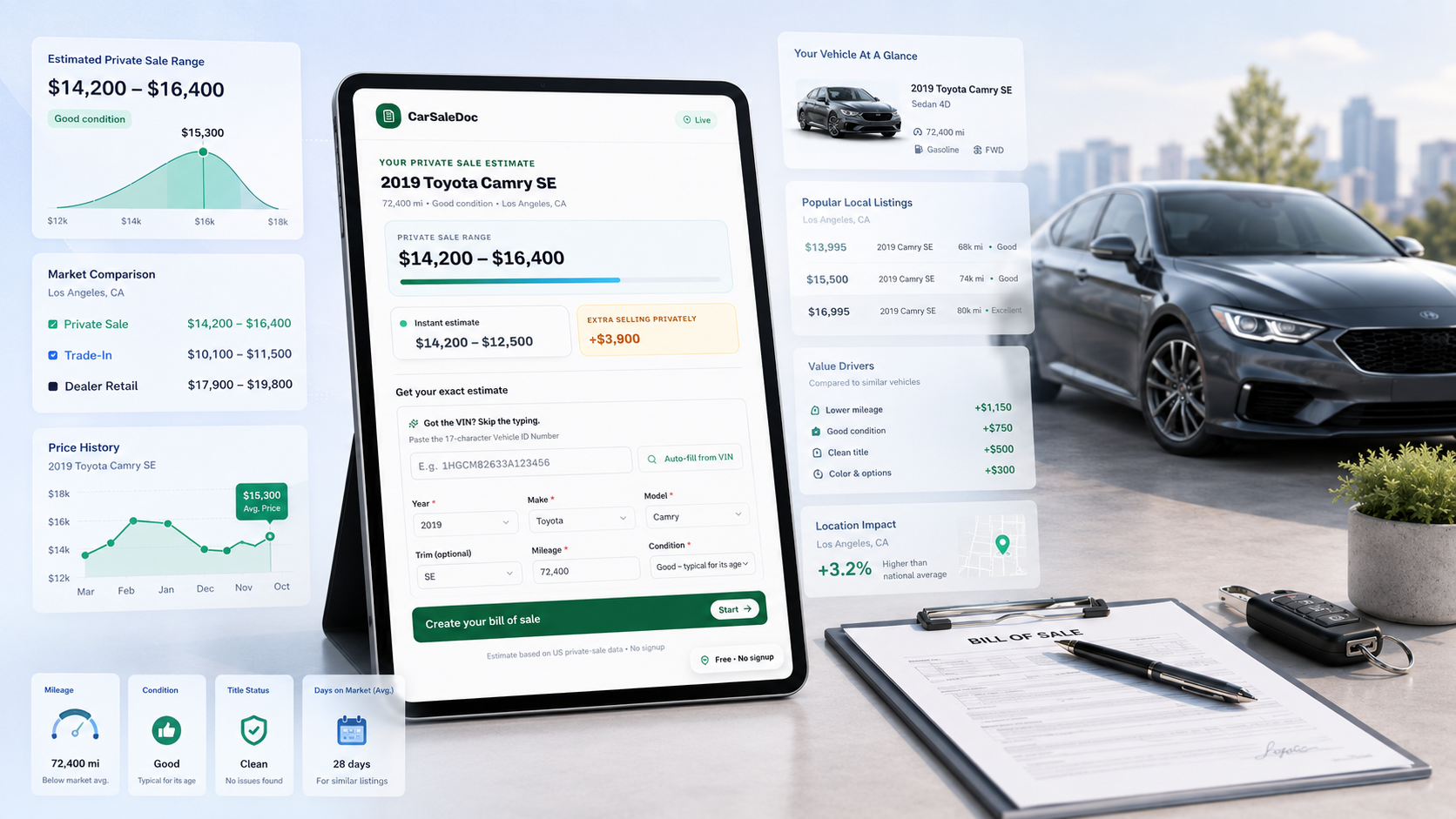
Private sale value sits between dealer retail (highest, what a dealer would ask) and trade-in (lowest, what a dealer would pay you). Private buyers skip the middle steps a dealer adds, so you can usually keep more of your California car's value by selling directly — typically $1,000–$3,000 more than trading it in.
Private sale value vs trade-in value
Highest price
What a dealer asks on the lot — includes reconditioning cost, dealer overhead, financing desk markup and a profit margin.
Middle ground — best for sellers
What individual buyers pay you directly. Below dealer retail (they take more risk, no warranty) but well above trade-in.
Lowest — but instant
What a dealer pays you to take the car. Convenient if rolling into a new purchase, but typically 25–30% below dealer retail.
How we calculate your estimate
We start from a current-year retail price for your year, make and model. We then apply a typical depreciation curve to roll back to your model year, and add adjustments for:
- Mileage vs typical for the model year
- Overall condition (poor → excellent)
- Title status (clean / rebuilt / salvage)
- Accident history (none / minor / major)
- State and ZIP-level demand
- Optional trim level if available
Tips to sell your car privately for more
- 1Detail the car: a $200 professional detail can add $500–$1,000 to the perceived value.
- 2Get a recent oil change and gather all maintenance records — buyers will pay more for documented service history.
- 3Take 10–15 well-lit photos: exterior from 4 angles, dashboard, odometer, seats, engine bay, tires.
- 4Price it 5–10% above your target so you have room to negotiate.
- 5Be honest about defects in the listing — surprises kill deals at the meetup.
- 6Always meet the buyer in a safe, public, well-lit location during the day.
- 7Accept cash, cashier's check (verified at issuing bank) or escrow — never personal checks for full amount.
- 8Sign a Bill of Sale at the meetup. Both parties keep a signed copy.
What to do after you agree on a price
A handshake is not enough. Document the transaction with a Bill of Sale — every US state expects one to title and register the vehicle. CarSaleDoc generates a California DMV-friendly bill of sale, captures both digital signatures, and emails the signed PDF to both parties.
Create a California Bill of SaleCalifornia-specific FAQs
Does failing a California smog test affect my private sale value?+
Yes, significantly. A car that won't pass smog cannot be registered by the buyer until repaired, so most California buyers will either walk away or demand a $1,000–$3,000 discount to cover repair costs. Sellers usually come out ahead by paying for the repair themselves before listing.
How does California's sales tax affect the price I should ask?+
California sales tax (7.25–10.75% depending on the city) is paid by the buyer at the DMV, not deducted from your sale price — but savvy buyers will factor it into what they're willing to pay. Pricing slightly below a round number (e.g., $14,900 instead of $15,000) tends to convert better because the buyer's all-in cost still fits their budget after tax.
Are EV / hybrid cars worth more in California than other states?+
Yes, typically $500–$2,500 more. California has the highest EV adoption rate in the US, more public charging infrastructure than any other state, and HOV-lane incentives that other states don't match. Tesla, Prius, Bolt and Ioniq models all hold their value better in California than nationally.
Does a Bay Area ZIP code add to the estimate vs Central Valley?+
Within California, identical cars often sell for 3–7% more in San Francisco, San Mateo, Santa Clara and coastal LA than in Fresno, Bakersfield or Riverside. Our calculator applies a state-level adjustment, so for a precise local comp we recommend cross-checking with Facebook Marketplace listings in your ZIP.
What is private sale value?+
Private sale value is the price you can realistically expect from another individual buying your car directly from you — without going through a dealer. It sits below dealer retail (because the buyer takes on more risk and no warranty) but above what a dealer would pay you on trade-in.
Is this an official appraisal?+
No. This is an informational price range based on general market data and the details you provided. It is not an appraisal, not a valuation, and not a guarantee of what your vehicle will sell for. For a binding valuation, contact a licensed appraiser, your insurance company, or your bank.
Why is private sale value different from trade-in value?+
Dealers pay less on trade-in because they need to recondition the car, store it, advertise it and resell it for a profit — plus they assume the warranty risk. Private buyers skip those middle steps, so you can charge closer to the dealer's retail price.