Texas Private Sale Car Value Calculator
Estimate what your car could sell for in a private sale based on mileage, condition, title status and location. See how a private sale compares with trading it in at a dealer.
Texas is the #1 pickup truck market in the US
Texas is the second-largest used-car market in the United States by volume, and the largest pickup truck market by a wide margin. The average used car sold privately in Texas runs roughly $26,000–$28,000 — about 1–3% below the national average for sedans and SUVs, but pickup trucks trade at a meaningful premium because of statewide demand from oil & gas, ranching and construction.
Within the state, prices are highest in Austin and the inner suburbs of Dallas and Houston, where tech-sector demand and tight inventory push prices up. The Permian Basin and Texas Panhandle markets are heavily truck-driven — a clean F-250 with low miles can sell for several thousand more in Midland than in Galveston. Dry climate, minimal road salt and rust-free undercarriages give Texas private sales a structural advantage versus Midwest or Northeast cars of the same age.
Top-selling used vehicles in Texas
Based on public 2025–2026 US used car market data. These models tend to sell faster and hold value better in Texas.
- Ford F-150 — best-selling vehicle in Texas for 40+ years running
- Chevrolet Silverado 1500 and GMC Sierra — strong throughout the state
- Ram 1500 — high demand in Houston and Dallas metros
- Toyota Tacoma and Tundra — premium pricing because of supply tightness
- Toyota Camry, Corolla and Civic — sedan demand concentrated in Austin and DFW
- Jeep Wrangler — popular in Hill Country and Central Texas
- Heavy-duty trucks (F-250/350, Silverado HD, Ram 2500) — work-truck market is huge
What's unique about selling a car privately in Texas
SPV (Standard Presumptive Value) doesn't change your sale price
The Texas Comptroller publishes an SPV for each year/make/model. The state collects sales tax from the buyer on the higher of the SPV or the bill-of-sale price (to prevent under-reporting). This doesn't change what the buyer pays you — only what they pay the county tax office. Don't artificially lower the bill-of-sale price to help the buyer skip tax; that's tax fraud.
No emissions inspection in most counties
Only the major DFW, Austin, Houston and El Paso counties require emissions testing. Statewide, you only need an annual safety inspection. Lower compliance overhead means more vehicles stay in the resale pool, which can slightly soften prices for older cars.
Rust-free vehicles command a premium
Texas cars from Houston, Beaumont and the Gulf Coast can have salt-air exposure, but most of the state has dry climate and no road salt. A genuinely rust-free Texas car — provable with undercarriage photos — sells for 5–10% more than the same VIN from a salt-belt state.
Gift transfers ($10 gift tax via Form 14-317)
Texas allows a flat $10 gift tax via Form 14-317 for transfers between immediate family. Like California, this doesn't change the underlying market value — only the tax owed at registration. Don't list as a gift if money is actually changing hands.
Tips to maximize your private sale price in Texas
- 1Photograph the undercarriage to prove no rust — Texas buyers and out-of-state buyers both value this heavily.
- 2If you're selling a truck, document any towing setup (hitch, brake controller, fifth-wheel prep) — that adds genuine resale value.
- 3List in early spring or late fall — Texas summer heat slows test-drive activity in July and August.
- 4Include the original window sticker if you have it. Texas buyers tend to be detail-focused, and original docs convert better.
Selling in another state? Try these calculators


How much is your car worth in a private sale?
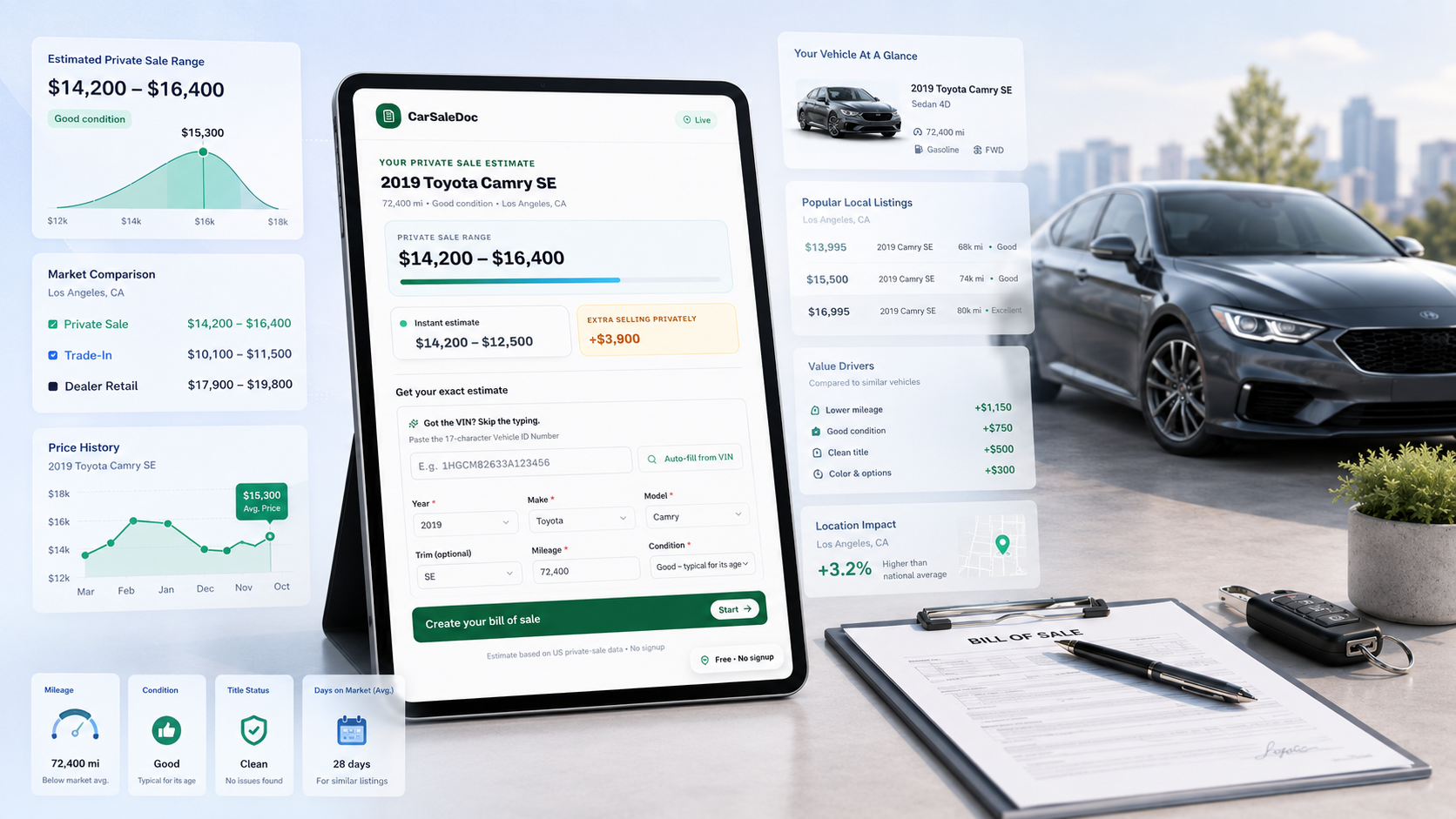
Private sale value sits between dealer retail (highest, what a dealer would ask) and trade-in (lowest, what a dealer would pay you). Private buyers skip the middle steps a dealer adds, so you can usually keep more of your Texas car's value by selling directly — typically $1,000–$3,000 more than trading it in.
Private sale value vs trade-in value
Highest price
What a dealer asks on the lot — includes reconditioning cost, dealer overhead, financing desk markup and a profit margin.
Middle ground — best for sellers
What individual buyers pay you directly. Below dealer retail (they take more risk, no warranty) but well above trade-in.
Lowest — but instant
What a dealer pays you to take the car. Convenient if rolling into a new purchase, but typically 25–30% below dealer retail.
How we calculate your estimate
We start from a current-year retail price for your year, make and model. We then apply a typical depreciation curve to roll back to your model year, and add adjustments for:
- Mileage vs typical for the model year
- Overall condition (poor → excellent)
- Title status (clean / rebuilt / salvage)
- Accident history (none / minor / major)
- State and ZIP-level demand
- Optional trim level if available
Tips to sell your car privately for more
- 1Detail the car: a $200 professional detail can add $500–$1,000 to the perceived value.
- 2Get a recent oil change and gather all maintenance records — buyers will pay more for documented service history.
- 3Take 10–15 well-lit photos: exterior from 4 angles, dashboard, odometer, seats, engine bay, tires.
- 4Price it 5–10% above your target so you have room to negotiate.
- 5Be honest about defects in the listing — surprises kill deals at the meetup.
- 6Always meet the buyer in a safe, public, well-lit location during the day.
- 7Accept cash, cashier's check (verified at issuing bank) or escrow — never personal checks for full amount.
- 8Sign a Bill of Sale at the meetup. Both parties keep a signed copy.
What to do after you agree on a price
A handshake is not enough. Document the transaction with a Bill of Sale — every US state expects one to title and register the vehicle. CarSaleDoc generates a Texas DMV-friendly bill of sale, captures both digital signatures, and emails the signed PDF to both parties.
Create a Texas Bill of SaleTexas-specific FAQs
How does Texas SPV affect what I should price my car at?+
The SPV doesn't change what you can charge a buyer — it only sets the floor that the state uses to calculate the buyer's sales tax. Price your car at fair market value (what a willing buyer will pay), not the SPV. If you sell well above SPV, that's fine; if you sell below SPV, the buyer still owes tax on the SPV unless they appeal.
Are trucks worth more in Texas than in other states?+
Yes. Pickup trucks — especially F-150, Silverado, Ram 1500 and the Tacoma/Tundra duo — trade at a 3–7% premium in Texas versus the national average because of work demand from oil, ranching and construction. Heavy-duty trucks (3/4-ton and up) can see an even bigger premium.
Does Texas's lack of emissions testing increase my car's value?+
Indirectly. Older vehicles that would fail California or New York emissions can still be registered and resold freely in most Texas counties, which keeps them in the resale pool longer. For a typical 5–10 year old vehicle, this has minimal effect on price.
How does selling a Texas car to an out-of-state buyer affect the price?+
Out-of-state buyers often pay 3–5% more for a Texas car because of the rust-free history (dry climate, no road salt). However, they typically want a Bill of Sale, a clean title and recent maintenance records before traveling — make sure all docs are ready.
What is private sale value?+
Private sale value is the price you can realistically expect from another individual buying your car directly from you — without going through a dealer. It sits below dealer retail (because the buyer takes on more risk and no warranty) but above what a dealer would pay you on trade-in.
Is this an official appraisal?+
No. This is an informational price range based on general market data and the details you provided. It is not an appraisal, not a valuation, and not a guarantee of what your vehicle will sell for. For a binding valuation, contact a licensed appraiser, your insurance company, or your bank.
Why is private sale value different from trade-in value?+
Dealers pay less on trade-in because they need to recondition the car, store it, advertise it and resell it for a profit — plus they assume the warranty risk. Private buyers skip those middle steps, so you can charge closer to the dealer's retail price.