New York Private Sale Car Value Calculator
Estimate what your car could sell for in a private sale based on mileage, condition, title status and location. See how a private sale compares with trading it in at a dealer.
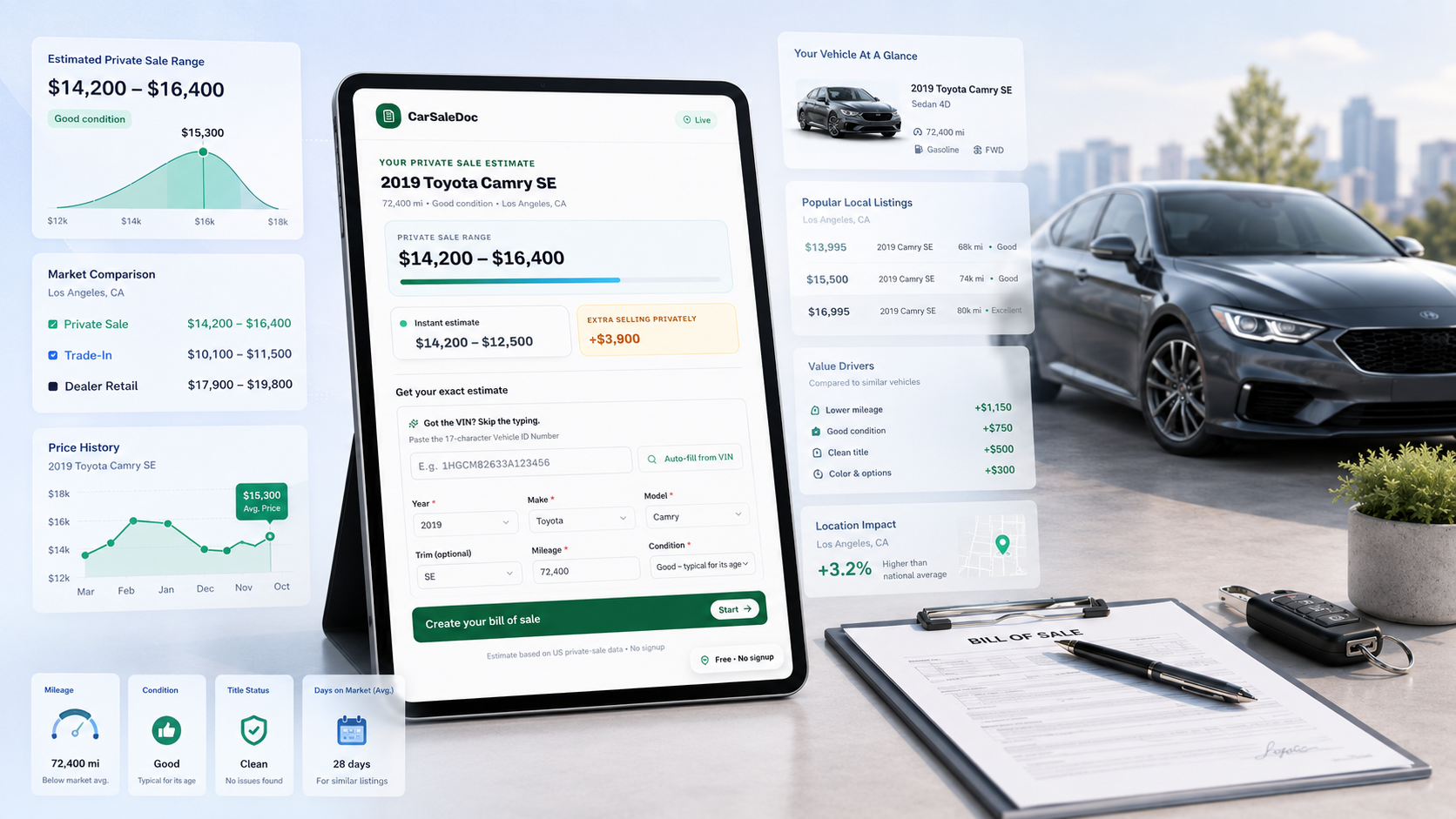
New York City and upstate are two different used-car markets
New York is the fifth-largest used-car market in the United States, but it's effectively two markets stitched together. New York City (the five boroughs plus Westchester and Nassau) trades at a 3–6% premium because of tight parking, high disposable income and limited dealer inventory. Upstate New York — from Albany north and west — trades 2–5% below the national average because of road salt, harsh winters and an older average vehicle.
The average used car sold privately in New York runs roughly $26,500 statewide, but the spread is wide: a 5-year-old Honda Civic with clean history might fetch $18,000 in Brooklyn and $16,000 in Buffalo. Garaged-and-driven-on-clean-roads pedigree matters more in New York than almost any other state, because the salt-belt's effect on undercarriage rust is real and measurable.
Top-selling used vehicles in New York
Based on public 2025–2026 US used car market data. These models tend to sell faster and hold value better in New York.
- Honda Civic, Accord and CR-V — dominant across the entire state
- Toyota Camry, Corolla and RAV4 — high demand in NYC and Long Island
- Subaru Outback and Forester — extremely popular upstate for AWD and winter capability
- Toyota Highlander and Honda Pilot — family SUV demand in suburbs
- Chevrolet Silverado, Ford F-150, GMC Sierra — work truck demand upstate
- Lexus RX and ES — luxury demand in Westchester, Long Island, NYC
- Off-lease BMW 3 Series and Mercedes C-Class — large supply in NYC market
What's unique about selling a car privately in New York
Road-salt rust is a real depreciation factor
From late November through March, New York roads — especially upstate — are heavily salted. After 5–7 years, undercarriage rust on brake lines, fuel lines and frame components becomes a real concern. Cars with documented garage history or undercarriage rust-proofing sell for 5–10% more than identical cars without.
NYC garage / off-street parking history adds value
In New York City, a documented off-street parking history is worth real money. Cars that have lived in a garage are spared the street-parking dings, sun fade and theft risk that plague curbside-only cars. Bring photos and the garage agreement to test drives — buyers notice.
Plates stay with the seller (and must be surrendered)
New York is a plate-keeps-with-seller state. You must surrender your plates to the DMV or transfer them to a different vehicle within 30 days, otherwise the DMV can suspend your registration and your insurance. The buyer registers under their own plate. This doesn't affect price but it's a paperwork step sellers commonly miss.
DTF-802 sales tax form
The buyer files a DTF-802 'Statement of Transaction' when they register the car. They pay sales tax (4–8.875% depending on the county) on the actual sale price as listed on your bill of sale. Pricing the car at $1 to help the buyer skip tax is fraud and can void the registration.
Tips to maximize your private sale price in New York
- 1If you can photograph a rust-free undercarriage, do it. New York buyers — especially upstate — will pay 5–10% more for proof.
- 2Document garage-kept and / or rust-proofed history. The Krown or Ziebart shop records carry real weight.
- 3Sell in April–June or September–October. Avoid mid-winter (test drives are miserable) and mid-summer NYC heat.
- 4If you're selling in NYC, list the actual neighborhood ("Park Slope, Brooklyn") not just "NYC" — buyers want a sense of where they're meeting you.
Selling in another state? Try these calculators


How much is your car worth in a private sale?
Private sale value sits between dealer retail (highest, what a dealer would ask) and trade-in (lowest, what a dealer would pay you). Private buyers skip the middle steps a dealer adds, so you can usually keep more of your New York car's value by selling directly — typically $1,000–$3,000 more than trading it in.
Private sale value vs trade-in value
Highest price
What a dealer asks on the lot — includes reconditioning cost, dealer overhead, financing desk markup and a profit margin.
Middle ground — best for sellers
What individual buyers pay you directly. Below dealer retail (they take more risk, no warranty) but well above trade-in.
Lowest — but instant
What a dealer pays you to take the car. Convenient if rolling into a new purchase, but typically 25–30% below dealer retail.
How we calculate your estimate
We start from a current-year retail price for your year, make and model. We then apply a typical depreciation curve to roll back to your model year, and add adjustments for:
- Mileage vs typical for the model year
- Overall condition (poor → excellent)
- Title status (clean / rebuilt / salvage)
- Accident history (none / minor / major)
- State and ZIP-level demand
- Optional trim level if available
Tips to sell your car privately for more
- 1Detail the car: a $200 professional detail can add $500–$1,000 to the perceived value.
- 2Get a recent oil change and gather all maintenance records — buyers will pay more for documented service history.
- 3Take 10–15 well-lit photos: exterior from 4 angles, dashboard, odometer, seats, engine bay, tires.
- 4Price it 5–10% above your target so you have room to negotiate.
- 5Be honest about defects in the listing — surprises kill deals at the meetup.
- 6Always meet the buyer in a safe, public, well-lit location during the day.
- 7Accept cash, cashier's check (verified at issuing bank) or escrow — never personal checks for full amount.
- 8Sign a Bill of Sale at the meetup. Both parties keep a signed copy.
What to do after you agree on a price
A handshake is not enough. Document the transaction with a Bill of Sale — every US state expects one to title and register the vehicle. CarSaleDoc generates a New York DMV-friendly bill of sale, captures both digital signatures, and emails the signed PDF to both parties.
Create a New York Bill of SaleNew York-specific FAQs
Does NYC pricing really differ from upstate pricing that much?+
Yes. The same vehicle typically sells for 5–10% more in the five boroughs, Long Island and Westchester than in Albany, Syracuse, Rochester or Buffalo. The NYC premium comes from disposable income, tight dealer inventory and a strong rental/rideshare buyer pool. Upstate's salt-belt rust and older average vehicles soften prices.
How much does road-salt rust hurt my New York car's value?+
Surface salt residue: little impact if you wash regularly. Undercarriage corrosion on brake lines, fuel lines or frame components: 5–15% off the sale price depending on severity. A vehicle that's failed a previous NY safety inspection because of frame rust is a hard sell at any price.
Should I surrender my plates before or after I sell my car in New York?+
Either way is fine, but you must do it within 30 days of the sale. Most sellers surrender after the buyer signs the bill of sale, then keep the surrender receipt as proof. Tell your insurance company you've surrendered the plates so they can cancel the policy and refund any unused premium.
Are off-lease luxury cars cheaper to buy in NYC?+
Often, yes. NYC has a large supply of 3-year off-lease BMW, Mercedes, Audi and Lexus vehicles coming out of expired leases. This can create good buyer deals — but if you're selling one, the high local supply means you're competing with hundreds of similar cars. Price aggressively and lead with maintenance records.
What is private sale value?+
Private sale value is the price you can realistically expect from another individual buying your car directly from you — without going through a dealer. It sits below dealer retail (because the buyer takes on more risk and no warranty) but above what a dealer would pay you on trade-in.
Is this an official appraisal?+
No. This is an informational price range based on general market data and the details you provided. It is not an appraisal, not a valuation, and not a guarantee of what your vehicle will sell for. For a binding valuation, contact a licensed appraiser, your insurance company, or your bank.
Why is private sale value different from trade-in value?+
Dealers pay less on trade-in because they need to recondition the car, store it, advertise it and resell it for a profit — plus they assume the warranty risk. Private buyers skip those middle steps, so you can charge closer to the dealer's retail price.